
How to Create a Social Media Marketing Strategy for Restaurants
For restaurants, social media is more than a gallery of dishes. It can help people discover a venue, understand its personality, decide what to order, picture an occasion and feel confident enough to make a reservation. But posting whenever someone has time is not a strategy. A useful social media marketing strategy connects the restaurant’s business priorities with specific audiences, content themes, visual assets, publishing routines and performance measures.
This guide explains how to build a practical plan for an independent restaurant, café, premium dining venue or multi-location brand. It also includes food photography ideas that can make the content more distinctive. The aim is not to chase every trend; it is to build a recognisable presence that helps the right people understand why they should visit, order or return.
Define What Social Media Needs to Achieve
Start with the business objective. A new restaurant may need local awareness and profile visits. An established venue may want more table reservations during quieter periods, stronger demand for a seasonal menu or awareness of private dining. A delivery-led restaurant may focus on product discovery and online orders. A premium venue may need to communicate ambience, service, chef expertise and occasions rather than compete only on discounts. Each objective affects the content, call to action and success metrics.
Choose one primary goal and a small number of supporting goals for each planning period. For example, a four-week campaign could promote a new tasting menu while maintaining regular content about signature dishes and the dining experience. Set a baseline using metrics the business can access, such as profile visits, website clicks, calls, direction requests, reservation enquiries, confirmed bookings or online orders. Social platforms can measure attention, but actual business results may require data from booking tools, the website or the restaurant team.
Understand Your Audience and Dining Occasions
Build audience segments around motivations and occasions, not only age and location. People may visit for a business lunch, a birthday, a date night, a family gathering, a quick coffee, a celebration or a delivery meal. They look for different information. A group organiser may want seating capacity and menus; a date-night customer may care about atmosphere; an office worker may need price, speed and weekday availability. Content should answer the questions that matter in each situation.
The restaurant’s catchment area also shapes the strategy. A local café may need visibility among nearby residents, offices and students, while a destination restaurant may need to explain why travelling across town is worthwhile. Review customer feedback, frequently asked questions, reservation notes and sales patterns to discover the occasions and dishes that matter. Use this knowledge to decide which stories to tell and which offers genuinely fit customer needs.
Choose Three to Five Repeatable Content Pillars
Content pillars keep the calendar balanced and help followers understand the restaurant. A useful starting point is to select three to five themes that can be repeated without making every post look the same. The pillars should reflect the restaurant’s strengths and audience questions, not simply the formats that are popular this week.
Pillar 1: Signature dishes and menu stories
Showcase dishes that define the restaurant, explain a special ingredient, introduce a seasonal item or demonstrate the preparation process. Give context: why the dish exists, what makes it different or how it fits the menu. Clear close-ups can make the food appealing, while chef commentary and short preparation clips add personality. Include useful details such as the dish name, whether it is new or seasonal and how customers can order it.
Pillar 2: Atmosphere, people and behind the scenes
Show the dining room at the right time of day, the team preparing for service, the chef’s approach, table settings or a small detail that makes the experience memorable. People want to know what an actual visit will feel like. Capture genuine scenes with permission and avoid presenting a staged view that does not match reality. Staff introductions and thoughtful behind-the-scenes clips can make the brand feel more human.
Pillar 3: Occasions, events and practical information
Create content around birthdays, anniversaries, business meals, family gatherings, seasonal celebrations, live music or private dining if these offers are genuinely available. Explain the practical details customers need to decide: group size, booking method, timing, menu options, location and any relevant terms. Useful posts may not be the most glamorous, but they can remove friction at the moment a customer is considering a visit.
Pillar 4: Guest experiences and community
Customer reviews, user-generated content, creator visits and community collaborations can provide social proof when handled transparently. Ask permission before reposting guest photos and follow applicable platform rules for paid partnerships. Respond graciously to feedback and avoid arguing publicly with dissatisfied guests. A complaint may reveal an operational issue; acknowledge it, move detailed resolution to a suitable channel and make sure the feedback reaches the team responsible.
Food Photography Ideas That Work on Social Media
Food photography is central to restaurant content because people use images to imagine taste, texture, portion size and presentation. Effective photography does not always require a dramatic setup. It requires a clear visual idea, deliberate styling, suitable light and an image that represents the real experience. Plan a shoot around menu priorities and marketing uses so one session can create assets for social posts, stories, website pages, menus and advertising.
Idea 1: Capture texture and the moment of preparation
A close crop can show a crisp crust, a glossy sauce, steam, a cut surface or a finishing garnish. Capture moments that communicate texture rather than relying only on a static plate. Keep the subject in focus and simplify distractions around it. If a dish is known for a particular preparation technique, record a short vertical clip as well as still images so the footage can be used in a Reel or story.
Idea 2: Show the dish in its real setting
Mix clean menu-style images with contextual shots of a table, hands sharing a dish, a chef plating food or a drink being served. Context helps communicate occasion and experience. For group dining, a wider composition may be more useful than a close-up. For a premium restaurant, thoughtful tableware, space and lighting may be part of the value proposition. Ensure every image accurately represents the restaurant and its service.
Idea 3: Create seasonal and campaign-led visuals
Plan visuals around genuine menu launches, festive offerings, tasting menus, brunches or limited-time products. Build a small campaign set with a hero image, supporting detail shots, vertical clips and images that explain practical information. Seasonal visuals should still follow the restaurant’s identity. Avoid using a festive template that looks disconnected from the brand or promoting an item after it is no longer available.
Idea 4: Use people and process to tell a story
A chef explaining an ingredient, a bartender finishing a signature drink or a baker preparing dough can communicate craft and care more effectively than a generic promotional graphic. Keep the story short and specific. Ask the team to share why a dish was created, what makes a method distinctive or how ingredients are selected. Real expertise gives the content a useful point of view and creates material that is harder for a competitor to imitate.
Plan a Food Photography Shoot Efficiently
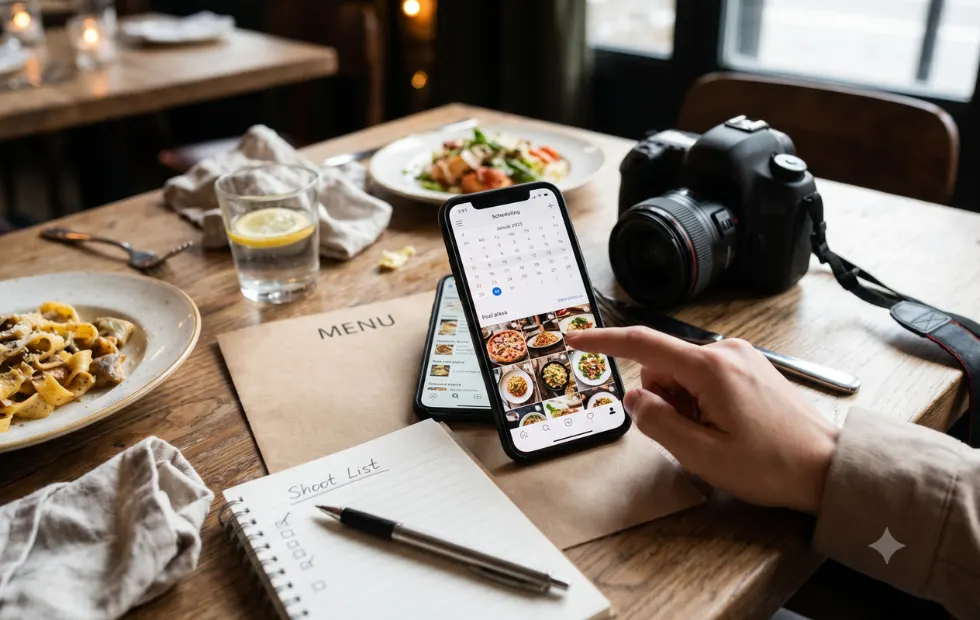
Begin with the content calendar and list the assets needed for each post or campaign. Choose priority dishes and confirm which ones will be available on the shoot date. Prepare a shot list covering hero angles, overhead views, close-ups, table scenes, people, process and vertical video. Decide where the assets will be used and what crop each placement needs. This is more efficient than photographing dishes at random and later discovering the team has no image that fits the planned campaign.
Coordinate the photographer, stylist, chef and restaurant manager. Prepare ingredients, plates, tableware, backgrounds and any props in advance. Schedule dishes in an order that protects food quality, and identify which items need immediate shooting. Choose light that makes the food look appetising without distorting its natural colour. Review a few images early in the shoot to confirm the direction. Keep edited images consistent, but do not over-retouch dishes in a way that creates unrealistic expectations.
Turn Content Pillars Into a Practical Calendar
A calendar prevents the feed from becoming a stream of last-minute sales messages. Plan a repeatable mix of formats: short videos, carousels, single-image posts, stories and occasional live or interactive content where appropriate. The exact frequency depends on the team’s capacity and the quality of material available. Consistency is more valuable than committing to a high volume that leads to rushed, repetitive posts.
For example, a week could include a signature dish Reel, a carousel answering questions about group bookings, a behind-the-scenes story, a guest experience shared with permission and a reminder about a genuinely available menu or event. Review the schedule against business priorities, seasonal dates and operational capacity. Leave some room for timely moments, but do not let trend-chasing replace the core strategy. Every post should have a reason to exist.
Write Captions and Calls to Action That Help Customers
A caption should add information or a point of view rather than merely repeat what is visible in the image. It might explain the flavour profile, preparation, suitable occasion, availability or booking process. Make the first lines clear, keep the language consistent with the brand and include practical information when it helps a customer decide. Do not force keywords awkwardly into captions or rely on a long list of unrelated hashtags.
Use a call to action that matches the post. A discovery post may invite people to view the menu or explore the location. A reservation-focused post may direct them to the booking link or ask them to contact the venue through the stated channel. An event post should include date, time, availability and booking details. Check the destination link and make sure the team can respond promptly. A strong post cannot rescue a broken reservation path or outdated menu.
Use Paid Promotion Carefully
Organic content helps build familiarity, while paid campaigns can extend reach or support a specific action. Promote content that already communicates a clear reason to visit, and define the campaign objective before choosing the format. A reach campaign, engagement campaign and reservation lead campaign are not interchangeable. Set the geography to match your realistic customer catchment area, use creative that reflects the venue and direct users to a relevant destination.
Test a small number of distinct creative ideas rather than making many nearly identical versions without a hypothesis. Compare the response by audience, placement and message. For lead campaigns, evaluate the quality of enquiries and whether staff successfully convert them into bookings. For awareness, look at relevant reach, frequency and content retention. Platform reporting should be combined with business signals where possible, and the restaurant should not claim every walk-in came from an ad unless there is evidence.
Measure, Learn and Improve the Strategy
A monthly review should answer four questions: what worked, what did not, why might it have happened and what will we change next? Review results by content pillar and format instead of judging every post by likes. A video with modest likes may bring meaningful profile visits or menu clicks; a popular post may create attention from people too far away to visit. Check link clicks, profile activity, calls, direction requests, reservations and orders where those measures are available.
Use observations as hypotheses, not absolute truths. If chef videos hold attention better than static product images, make more of them and test a different opening or length. If group dining posts drive qualified questions, clarify the package, capacity and booking process. If a promoted post attracts irrelevant enquiries, review the targeting, message and call to action. Keep a record of changes and learnings so the team can make decisions based on accumulated evidence rather than personal preference alone.
Common Restaurant Social Media Mistakes
Common mistakes include posting only promotional offers, relying on low-quality or inconsistent imagery, copying competitors, forgetting location details, failing to answer messages, promoting unavailable dishes and tracking only follower growth. Another mistake is expecting social media to compensate for poor service or a confusing booking process. Marketing can bring the restaurant to someone’s attention, but the actual experience determines whether that person becomes a repeat customer or recommends the venue.
Avoid making unsupported claims, using guest images without permission or creating offers with unclear conditions. Keep menu details accurate and coordinate campaign timings with the operations team. Use trends only when they fit the brand and can be executed well. A recognisable voice and dependable experience are more durable than a one-off post that receives attention but confuses the audience.
Frequently Asked Questions
How often should a restaurant post on social media?
There is no single frequency that suits every venue. Choose a schedule that your team can maintain while producing useful, high-quality content. Start with a manageable calendar, watch which formats and topics help the business and adjust the pace based on capacity and results.
Do restaurants need professional food photography?
Professional photography can be especially valuable for menu launches, delivery listings, websites, brand campaigns and paid advertising. Smartphone content can still be useful for timely stories and behind-the-scenes footage when lighting, framing and accuracy are good. A planned mix often gives the restaurant both polished campaign assets and authentic everyday content.
Should a restaurant boost every popular post?
No. Choose promotion based on the business objective, audience relevance and destination. A popular post is not automatically a good sales ad. Test whether the creative gives people a reason to act and whether the campaign can measure the outcome that matters.
Conclusion: Make Every Post Part of a Larger Guest Experience
A practical restaurant social media strategy starts with business goals, audience motivations and clear content pillars. Food photography makes the experience tangible, while useful captions, reliable booking information, consistent community management and appropriate paid promotion turn attention into an opportunity. Measure what matters, listen to customer feedback and improve the plan each month.
A practical restaurant social media strategy starts with business goals, audience motivations and clear content pillars. Food photography makes the experience tangible, while useful captions, reliable booking information, consistent community management and appropriate paid promotion turn attention into an opportunity. Measure what matters, listen to customer feedback and improve the plan each month.